Here is the situation this column is about. The deal was agreed in a chat, you sent your side — fiat by bank transfer, or crypto to the desk's address — and the USDT never came. Or it came in part, or the desk shows a screenshot, or your funds are "held by compliance" pending a fee. Where you go depends on which of these it is, and in an OTC deal that can be established quickly: unlike a hacker, a counterparty has a name, a handle, an address and a history.
Which distinction do I make first?
An unpaid OTC deal is not automatically a theft, and treating it as one sends people to the wrong door. You sent the funds yourself, to someone you were talking to; an exchange and a police unit will both read that as a commercial dispute until it is shown that the other side never intended to pay. In return you have what a theft victim never has: a party who can be identified, and funds that may sit at a venue with a compliance team.
So the first thing I would establish is which of four things happened.
A genuine dispute with a real desk. The desk exists, answers, names a reason — wrong network, address mismatch, a hold on the incoming transfer, a rate disagreement — and puts it in writing. That is resolved with documents and, if needed, lawyers where the desk is; not yet a matter for the police or for a tracing firm.
A real desk with a real problem of its own. It received your transfer and then had its account frozen — by an exchange or by the stablecoin issuer — because your funds, or someone else's in the same account, were flagged. Nobody at the table controls that timeline.
A fraud that was always going to end this way. The "desk" was a website and a chat. Payment was demanded first, a small "test" deal went through to build trust, the large one did not, and now there is silence — or a request for a "release fee", a "tax", an "AML clearance". This is the fake-exchange scheme in OTC clothing; the pattern is on the fake exchange page.
An intermediary who kept the money. A broker between you and a desk received your side and never passed it on; the counterparty is the individual, not the desk.
Two tests separate the first two from the last two within a day. A real counterparty answers with something you can check — a hash, a written reason, a legal entity in a register. And a legitimate counterparty does not need more of your money in order to return it: a fee to "release" funds is a scheme's next step, not a step towards payment. I would treat it as a strong warning sign, and I would not pay it.
What should you save before anything else?
Everything that follows is built on what exists in writing today, and in a fraud the chat can be gone within days. Save the agreed terms as they appear in the conversation: amount, rate, who sends first, the deadline. Save the addresses and the hashes — your outgoing transaction from your own wallet history, the address the desk gave you, any hash the desk claims for its side, so it can be checked in an explorer. Save the counterparty as they presented themselves: website, company name, registration number, handle, the group where you found them. If there was a bank leg, keep the confirmation with the receiving account name — a record with a name on it, which the crypto leg is not. And keep every message, uncropped, including the ones after the deal went wrong: the excuses and the fee requests are evidence of intent.
Where do you go, in order?
The counterparty, once, in writing. The terms, your hash, the amount outstanding, a deadline, a request for a written explanation. Not to negotiate — to create the record of what you asked and what they answered. Send nothing further on the strength of the reply.
The platform, if there was one. An exchange's own P2P or OTC service typically has a dispute procedure and a hold it can act on — use it at once, with the hashes and the chat attached. If the counterparty's receiving address turns out to be at an exchange, its compliance team can be sent the evidence. Based on our case experience, responses to freeze requests may sometimes be received within 2–4 days at an exchange and within 24–62 hours in stablecoin issuer cases. Actual timelines depend on the specific circumstances. Neither an exchange nor an issuer acts on a chat log alone.
The police. If there are indications of fraud, report the case to the police where you live and to the national cybercrime portal, with the supporting evidence attached. A police report can help support or formalise a freeze request at an exchange. The timing depends on the exchange, jurisdiction, evidence provided and law-enforcement involvement. It is also the document later parties usually ask for. File it even if the counterparty is abroad; the report is about your loss, not their location. Where to file, by country, is on the reporting page.
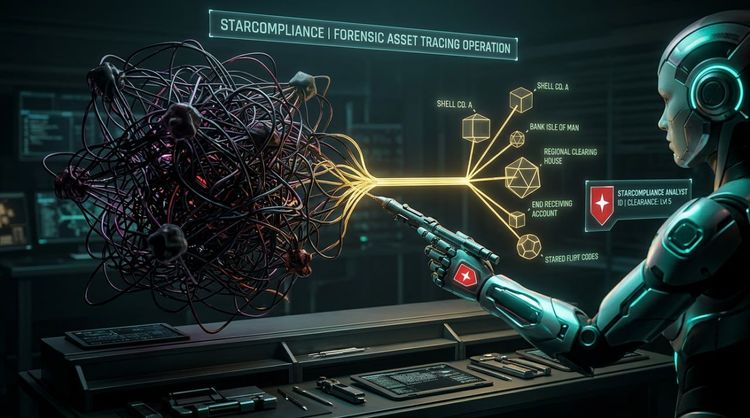
The trace, if the loss justifies it. A report establishes that a loss occurred. It does not establish where the funds are now — yet in many cases, a freeze request or court application needs to establish where the funds are currently located and provide supporting evidence. A trace follows what you sent, through whatever swaps followed, to the venue where it stopped, with a hash behind every step; the counterparty's own paperwork, real or fake, rarely contains that. This is where a firm like ours comes in — with one limit stated up front: we do not work with certain OTC channels involving China. The assessment is free, and we aim to respond within two business hours; the answer may be that there is nothing to pursue. Our published threshold is a loss from $200,000, with smaller cases reviewed individually.
Lawyers where the counterparty is, if the counterparty is real. A desk with a legal entity can be sued, and a court in its jurisdiction can order the funds returned — ordinary litigation by lawyers admitted there (in our cases partner firms; we do not practise law). For a fraud with no entity behind it, the route runs through the venue where the funds stopped instead, which is why the trace comes first.
Why speed matters more here than almost anywhere
What makes these cases more favourable than a wallet drain is also what makes them time-limited: funds sent to a desk or a broker can land at an exchange, where someone can act — but they can leave quickly. A deal that went wrong this week is a live case. After six months, recovery may become more difficult, and the case may increasingly shift toward evidentiary and law-enforcement work. And a freeze is only the fast half: it stops the money, it does not move it, and the return — on a court decision, or through the issuer's reissue procedure — is measured in months. The timelines, stage by stage, are on our figures page and the recovery process page.
Which mistakes should you avoid?
Paying to "release" the funds — the requests continue until you stop. Trusting the test deal: a small trade that paid out on time proves only that the counterparty can pay a small trade, and frauds run one precisely to set up the large one. Chasing the counterparty instead of building the record: days spent in the chat are days in which the funds leave the venue. And sending first to someone you cannot identify: a new counterparty should be an entity you can find in a register, a person who has passed identification, or a platform with escrow — or the first tranche should be one you can afford to lose. The checks we publish on the verification page were written for recovery firms, but they work on a desk just as well.
If the funds are traceable and the loss is significant, send us the transaction hashes: the assessment is free, and we aim to respond within two business hours, including when the answer is that there is nothing to pursue. Write through the contact page or message @StarCompliance on Telegram.
Questions people ask about unpaid OTC deals
Is an unpaid OTC deal a theft?
Not at first sight. You sent the funds yourself, to someone you were talking to, so an exchange and a police unit will read it as a commercial dispute until it is shown that the other side never intended to pay.
The desk asks for a fee to release my USDT. Should I pay?
No. A legitimate counterparty does not need more of your money in order to return it; a fee to "release" funds is a scheme's next step, not a step towards payment.
What should I save first?
The agreed terms as they appear in the chat, your outgoing transaction hash, the address the desk gave you, any hash the desk claims for its side, the counterparty as they presented themselves, the bank confirmation if there was a bank leg, and every message, uncropped.
Should I report an unpaid OTC deal to the police?
If there are indications of fraud, yes. Submit the report with the supporting evidence, even if the counterparty is abroad. A police report can help support or formalise a freeze request at an exchange; the timing depends on the exchange, jurisdiction, evidence provided and law-enforcement involvement.
Can the funds be frozen?
Only if they reached a party that can act. If the counterparty's receiving address is at an exchange, a freeze request can be sent there with a proper evidence pack. Based on our case experience, responses may sometimes be received within 2–4 days at an exchange and within 24–62 hours in stablecoin issuer cases; actual timelines depend on the specific circumstances. Neither an exchange nor an issuer acts on a chat log alone.
Do you take OTC cases?
The assessment is free, and we aim to respond within two business hours; our published threshold is a loss from $200,000, with smaller cases reviewed individually. We do not work with certain OTC channels involving China.
This column is informational material, not legal advice, and no outcome is promised: decisions on freezing and releasing funds are made by exchanges, issuers and courts. Figures are from StarCompliance casework and are published, with the period each covers, on our figures page.